Call Us Today!
(973) 625-1491
New Patients
(973) 221-5407


When teeth are missing for a prolonged period, the jawbone can shrink or resorb. This natural process, known as atrophy, reduces the quality and quantity of bone available for dental implants. Over time, it can also lead to shifting of remaining teeth and noticeable changes to facial structure. In many cases, patients with significant bone loss may not initially be candidates for implants.
Fortunately, modern dentistry allows us to regenerate bone where it’s needed. This not only makes dental implant placement possible but also restores proper function and improves facial aesthetics.
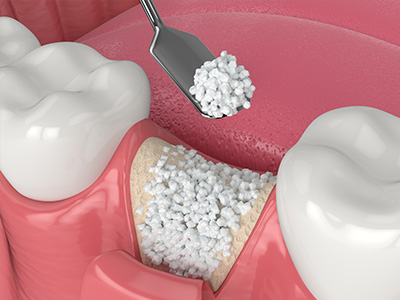
Major bone grafting repairs sites with insufficient bone due to extractions, gum disease, or injuries. The grafted bone can come from a tissue bank or from your own body—commonly the jaw, hip, or tibia. Sinus bone grafts are also performed to restore bone in the upper back jaw. Special membranes may be used to protect the graft and encourage regeneration, a process known as guided bone regeneration or guided tissue regeneration.
Large defects in the jaw, caused by trauma, tumor removal, or congenital conditions, may require major bone grafting. In these cases, bone is harvested from areas such as the skull, hip, or tibia. These procedures are usually performed in an operating room and may require a short hospital stay.
After a tooth extraction, the socket typically fills with bone in two to three months if the surrounding walls are thick. However, in areas with thin bone—often the upper and lower front teeth—healing may be unpredictable. A bone graft placed at the time of extraction helps maintain the necessary width and volume for future implant placement.
For teeth removed many years ago, the jaw ridge may be very thin. In these cases, a bone graft can be placed alongside the existing bone and allowed to heal for several months. Once the graft has integrated, the implant can be placed. Bone grafting is usually a comfortable in-office procedure, and a variety of graft materials are available, including your own bone.
If the sinus cavities in the upper jaw are very low or large, there may not be enough bone for implant placement. This situation often occurs when back upper teeth were lost years earlier. A sinus grafting procedure can restore the bone height needed for implants.
Sinus grafting is usually performed in the office under local anesthesia, sometimes with sedation. In many cases, the implant can be placed at the same time as the graft, reducing overall treatment time.
Bone grafting is a surgical procedure that rebuilds or augments the jawbone where it has thinned or resorbed. Patients commonly need grafting after tooth loss, trauma, or advanced periodontal disease because the jaw naturally shrinks when teeth are missing, reducing the volume needed to support dental implants or stable restorations. Restoring bone volume helps maintain facial contours and prevents shifting of adjacent teeth that can compromise function and appearance.
Grafting can be tailored to the size and location of the defect, from small socket preservation to larger ridge augmentation or block grafts. The goal is predictable regeneration that creates a stable foundation for implants or other restorative work. Modern techniques and biologic membranes improve success rates and reduce recovery time compared with older methods.
Several graft materials are available, including autografts, allografts, xenografts, and synthetic grafts. An autograft uses the patient’s own bone, which offers excellent compatibility and healing potential, while allografts come from screened human donors and provide a convenient, readily available option without a second surgical site. Xenografts derive from animal sources and are processed to reduce immunologic risk, and synthetic materials such as calcium phosphate provide an osteoconductive scaffold for new bone growth.
Clinicians often select a material based on the defect size, the patient’s medical history, and the desired healing timeline. In many cases a combination of materials and biologic enhancers is used to optimize regeneration and stability. Your periodontist will explain the advantages and trade-offs of each option during treatment planning.
Major bone grafting is considered when there is a large or complex defect that smaller grafts cannot reliably repair. Causes include long-standing tooth loss with severe ridge atrophy, trauma, tumor resection, congenital defects, or advanced infection that leaves a substantial void in the jaw. These cases often require block grafts or onlay grafts harvested from sites such as the jaw, hip, or tibia to recreate adequate bone volume and shape.
Because major grafts can involve more extensive surgery, they are usually planned carefully with imaging such as CBCT scans and may be performed in an operating room setting. The procedure can require temporary external or intraoral fixation and a staged approach where grafting is followed by months of healing before implants are placed. Your surgical team will discuss the rationale, timeline, and expected outcomes before proceeding with a major reconstruction.
Successful dental implants need sufficient height and width of quality bone to achieve long-term stability and proper alignment with neighboring teeth. When the natural ridge lacks volume, bone grafting rebuilds the supporting structure so an implant can be placed in an ideal position and withstand the forces of chewing. Without adequate grafting, implants may fail to integrate or may be placed at a compromised angle that affects function and esthetics.
Depending on the case, grafting can be performed at the time of extraction, before implant placement, or simultaneously with implant surgery if primary stability is achievable. Staged grafting followed by delayed implant placement is common for larger defects and increases the predictability of osseointegration. At A R Periodontics, PC our treatment plans emphasize predictable protocols that match graft type and timing to each patient’s clinical needs.
Socket preservation is a grafting procedure performed immediately after tooth extraction to maintain the shape and volume of the alveolar ridge. When a tooth is removed, the surrounding bone often collapses inward; placing graft material in the empty socket helps preserve width and height, making future implant placement simpler and more predictable. This approach is especially useful in esthetic zones or where thin buccal plates increase the risk of significant resorption.
Socket preservation is typically done in the same visit as the extraction or shortly thereafter and can reduce the need for more extensive grafting later. The procedure is minimally invasive, uses a variety of graft materials, and is often accompanied by a protective membrane to guide tissue healing. Your periodontist will recommend socket preservation when long-term restorative planning indicates a benefit to maintaining ridge dimension.
A sinus lift, or sinus graft, increases bone height in the upper posterior jaw when the maxillary sinuses are positioned too close to the ridge for implant placement. Over time, missing back upper teeth can allow the sinus floor to expand downward, leaving insufficient bone for implants of adequate length. During the procedure the sinus membrane is carefully elevated and graft material is placed beneath it to create new vertical height.
Sinus grafting can be performed through a lateral window or a crestal approach, and in many cases implants can be placed at the same time as the graft when primary stability is possible. Healing typically requires several months before full integration, but the procedure reliably creates the bone volume needed for long-term implant support. Your provider will assess sinus anatomy with three-dimensional imaging to select the safest and most effective technique.
The healing timeline for a bone graft varies by graft size, material, location, and individual patient factors, but most grafts require several months to mature before implants are placed. Small socket grafts may integrate sufficiently in two to four months, while larger ridge augmentations and sinus lifts often need four to nine months of healing to achieve predictable bone quality. During this phase the graft remodels as native bone replaces the graft material and establishes a solid foundation.
Factors such as smoking, systemic health conditions, and medication use can slow osseous healing, so clinicians tailor timelines to each patient and monitor progress with follow-up exams and imaging. Regular periodontal maintenance and adherence to post-operative instructions support optimal integration. Your surgeon will advise on the expected interval and perform checks to confirm readiness for the next restorative step.
Recovery after bone grafting typically involves some swelling, mild to moderate discomfort, and temporary changes in diet and oral hygiene routines. Patients are usually advised to eat soft foods, avoid strenuous activity for several days, and follow specific cleaning protocols around the surgical site to minimize the risk of infection. Pain and swelling are managed with prescribed or recommended medications and tend to peak within the first 48 to 72 hours before gradually improving.
Follow-up visits are important to monitor healing, remove sutures if needed, and review when to resume normal brushing and flossing. Maintaining good overall health, avoiding tobacco, and attending scheduled appointments significantly improve outcomes. If you experience persistent pain, unusual drainage, or fever, contact the office promptly so the team can assess and intervene as necessary.
As with any surgical procedure, bone grafting carries potential risks such as infection, graft exposure, delayed healing, and, in rare cases, failure of the graft to integrate. Specific sites may have additional considerations; for example, sinus grafting carries a small risk of sinus membrane perforation, which can usually be repaired during the procedure. The likelihood of complications is reduced by careful patient selection, thorough preoperative planning, and strict adherence to sterile technique.
Many complications are manageable when identified early, so prompt communication with the surgical team is essential if unusual symptoms arise. Thorough medical history review and imaging help mitigate risks, and clinicians will discuss individual risk factors and expected outcomes before obtaining informed consent. Proper postoperative care and follow-up further minimize complication rates.
When an autogenous graft is indicated, bone is typically harvested from intraoral sites such as the mandibular ramus, chin, or tuberosity, which provide accessible sources with reduced morbidity. For larger reconstructions, extraoral sites such as the hip (iliac crest) or tibia may be used and generally require coordination with an operating room and anesthesia team. The choice of donor site balances the amount of bone needed with the goal of minimizing pain, functional impact, and potential complications at the harvest location.
Harvesting autogenous bone provides the benefit of live cells and natural growth factors that can enhance healing, but it also adds a second surgical site and recovery considerations. Your surgeon will explain the rationale for autograft versus alternative materials and outline what to expect from the harvest procedure and subsequent recovery. Careful surgical technique and postoperative management reduce discomfort and promote uneventful healing at both the donor and recipient sites.
Preparation begins with a comprehensive consultation that includes medical and dental history, a clinical exam, and three-dimensional imaging to precisely evaluate bone volume and anatomy. Your clinician will review medications, health conditions, and habits such as tobacco use that may affect healing and will provide personalized instructions for preoperative care, including any necessary medication adjustments. Clear communication about expectations, timeline, and the planned grafting technique helps ensure a smooth experience.
On the day of surgery patients should arrange for transportation if sedation or general anesthesia is planned and follow fasting or medication guidelines provided by the office. After the procedure, follow-up appointments will be scheduled to monitor healing and determine the appropriate time for implant placement or further restorative work. The team at A R Periodontics, PC is available to answer questions throughout the process and to support each patient from planning through recovery.